Explaining Common Types of Spill Containment
Spill containment helps protect people, property, and the environment against leaks and chemical spills. Industrial facilities, temporary job sites, and storage areas all rely on some form of containment to manage risk and stay compliant with safety standards.
The right containment setup depends on the type of liquid involved, how it’s stored, and the conditions around it. Knowing the most common options helps teams choose reliable solutions before problems occur.
What Is Spill Containment?
Spill containment refers to any method, product, or system used to control the release of liquids, especially hazardous or regulated substances. It helps keep spills confined to a specific area to prevent environmental contamination, workplace injuries, or equipment damage.
Many containment solutions are designed to temporarily hold liquids until they can be cleaned up or properly disposed of. Others are built for long-term use as part of routine operations. In both cases, containment serves as a frontline defense that helps reduce liability and keep operations running safely.
Primary Categories of Spill Containment Solutions
Spill containment solutions generally fall into two categories: primary containment and secondary containment.
Primary containment holds the liquid during normal use. This includes tanks, drums, or any closed container designed to store fluids safely.
Secondary containment
captures leaks or spills if the primary container fails. These systems act as a backup layer of protection and are often required in facilities handling hazardous materials. Examples include berms, trays, pallets, and liners positioned under or around the primary container.
Common Types of Spill Containment Products
Spill containment products are built to match different environments, storage needs, and response plans. Some are lightweight and portable for quick deployment, while others are permanent fixtures integrated into facility layouts.
Understanding the function of each product type helps narrow down which solution is best for specific materials, volumes, and operating conditions. The following sections break down some of the most widely used options across industrial and commercial settings.
Spill Berms
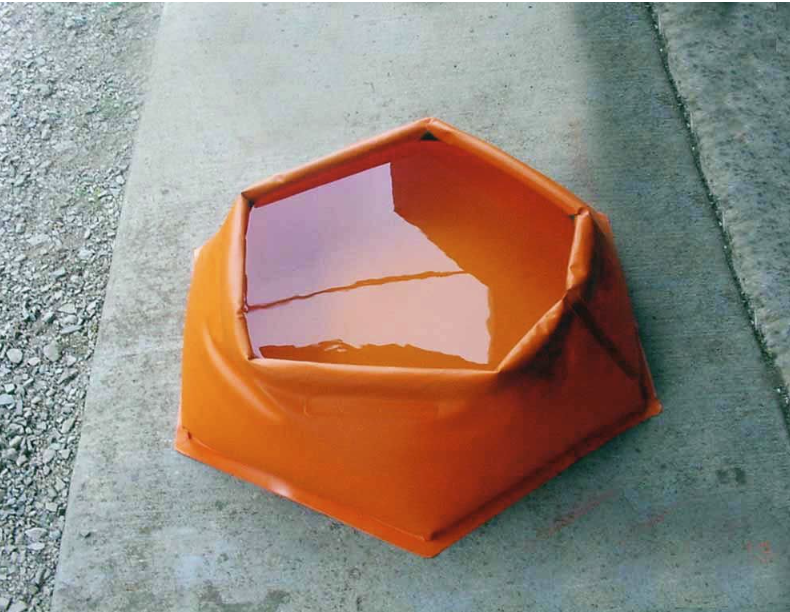
Spill berms create a physical barrier around equipment, containers, or vehicles to keep liquids from spreading. They’re commonly used during fuel transfers, maintenance work, or in areas where spills are more likely to occur.
Some berms are flexible and collapsible, making them easy to transport and set up in the field. Others are more rigid and designed for long-term containment. Depending on the application, berms can be built to withstand oils, fuels, chemicals, or corrosive liquids.
They’re especially useful in temporary work zones or remote locations where quick deployment and reliability are priorities.
Containment Pools and Trays
Containment pools and trays are used to catch drips, leaks, or spills directly beneath tanks, drums, machinery, or small containers. These products are ideal for indoor environments or controlled work areas where space is limited and spill volumes are more predictable.
Trays are typically shallow and compact, designed for minor leaks or routine handling of smaller volumes. Containment pools, on the other hand, offer more capacity and may include collapsible walls or reinforced sides for added durability.
Both options help keep work areas clean and reduce the risk of slip hazards or chemical exposure during regular operations.
Secondary Containment Liners
Secondary containment liners provide a protective barrier beneath or around tanks, storage units, and other primary containers. These liners are often used in containment basins, under storage pads, or within berm systems to prevent liquids from reaching soil or drainage systems.
They’re commonly made from chemical-resistant materials that can handle exposure to fuels, oils, and industrial chemicals over time. In large-scale applications, liners are often custom-fabricated to fit specific dimensions and configurations.
Liners add an extra level of protection in case of tank failure or long-term leakage, especially in facilities where environmental compliance is a priority.
Spill Containment Pallets
Spill containment pallets combine storage and secondary containment in one unit. Drums or small tanks are placed on top of the pallet, which has a built-in sump to catch any leaks or drips. These are commonly used in warehouses, production facilities, and storage areas handling oils, chemicals, or corrosive liquids.
Most pallets are made from durable, chemical-resistant plastic and can handle the weight of fully loaded containers. Some are equipped with grates or removable decks for easy cleaning.
Spill containment pallets help keep fluids off the floor, simplify compliance, and reduce cleanup time if a container leaks.
Drain Covers and Seals
Drain covers and seals are used to block off floor or storm drains during a spill event. These products help prevent hazardous liquids from entering drainage systems, where they could cause environmental damage or regulatory violations.
Many are made from flexible rubber or polyurethane and can be quickly deployed in emergency situations. Some are reusable, while others are designed for single use, depending on the type of liquid involved.
They’re a simple but effective tool for facilities that store or handle chemicals near drains, loading docks, or outdoor work areas.
Custom Spill Containment Solutions
Standard containment products don’t always meet the needs of unique layouts, equipment setups, or regulatory requirements. Custom spill containment solutions are designed to match specific dimensions, material needs, and performance goals that off-the-shelf options can’t address.
These solutions might include oversized liners, fitted covers, modular berms, or hybrid systems that combine several containment methods into one design. Custom fabrication helps avoid workarounds and makes it easier to meet safety and compliance goals without interrupting operations.
Carolina CoverTech’s Expertise in Spill Containment
Carolina CoverTech works with companies that need reliable, purpose-built spill containment solutions. Using
industrial sewing,
RF welding, and rigid-to-flexible material conversions, we produce containment products designed for durability, chemical resistance, and long-term use.
We help clients develop custom liners, berms, trays, and other containment systems based on the exact needs of their operation. Our in-house design and development process makes it easier to solve space constraints, meet compliance requirements, or handle specialized fluids.
For portable setups or large-scale permanent installations, we bring the engineering focus and manufacturing experience to make it work.
How to Choose the Right Spill Containment Solution
Selecting the right spill containment product depends on the type of liquid, the volume stored or transferred, and the conditions where the containment will be used. High-traffic areas may need rugged, low-profile solutions. Outdoor setups may require UV-resistant materials and custom sizing.
The goal is to
match the containment method to the real-world demands of the space. Portable products might work best for temporary work zones, while fixed systems are often better for long-term storage or recurring use.
If your team is dealing with unique containment challenges or needs help deciding on the right approach,
contact us to start a conversation about custom spill containment solutions.
need a contract manufacturer?
Carolina CoverTech can build to your exact specs. Request a quote today.